


On raising children who don’t just survive difficulty, but grow stronger because of it.
By: Ashleigh Sacks
“Not hands-off. Not hands-on. Hands nearby.”
Ashleigh Sacks is an Educational Psychologist and Head of Wellbeing at Yeshiva College, with thirteen years of experience across schools and private practice. She works with children, families and educators to build emotional resilience, self-regulation and wellbeing from the inside out and considers herself a fellow traveller, continuously learning and growing alongside the families and children.
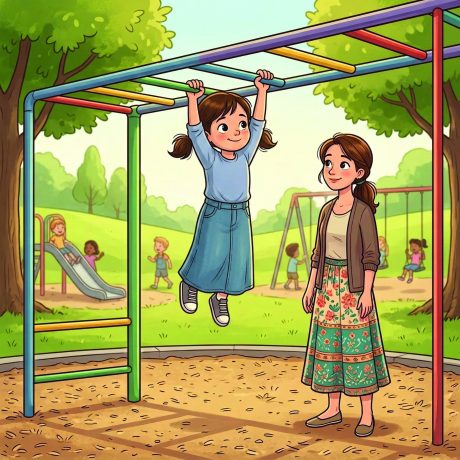
My daughter was two years old when she decided the monkey bars were hers to conquer. Every single day, with the focused determination of a tiny CEO, she would launch herself upward, oblivious to any danger, entirely certain of her destiny. Each time she got stuck and didn’t know the way down, she would cry, and I would run over, lift her to safety, and quietly calm my own new-mum nerves in the process. Then she would turn around and go straight back. This was not a phase. This happened at every jungle gym we encountered. Every single one.
It took some time, and the particular kind of clarity that only a toddler-mum brain eventually produces, to arrive at a simple truth: I couldn’t stop her from climbing. But I could help her feel like she could get herself down. So, the next time she got stuck, I didn’t run over. Instead, I got close and asked her a question that still makes me smile to say to a two-year-old: “What’s your plan?” She looked at me. I pointed to where her foot could go. She tried. She wobbled. She cried a little. I stayed close. And slowly, rung by rung, she made it across, and beamed with pride. She went on to conquer many a jungle gym after that. Sometimes with my help. Sometimes entirely on her own. Psychology has a word for what happened on that climbing frame. Children who don’t merely survive challenge but grow stronger because of it are called anti-fragile, a term borrowed from philosopher Nassim Taleb. But these are not simply children who were believed in; every parent believes in their child. They are children whose adults had the courage to allow them to struggle. In thirteen years of working with children and families, in schools and in private practice, that is the pattern I return to again and again. The children who flourish are rarely the ones who had the easiest ride. They are the ones whose adults stayed close enough to support, but trusted them enough not to do it for them.
“You can do for them. The question is: should you?”
Here is the paradox at the heart of modern parenting. The online parenting education market is now worth over two billion dollars globally. Parents today are reading more, listening to more podcasts, and thinking more carefully about their children’s emotional lives than any generation before them. This generation is more attuned, more informed, more intentional, and that is genuinely worth acknowledging. And yet. In our determination to give our children the smoothest, most supported experience of childhood, we can, without ever meaning to quietly take away the very thing they need most: the experience of finding their own way. You can do for them. The question is: should you?
When we step in too quickly, and I say this with enormous warmth, because I have done it more times than I can count, we send a message we never intended. Without a single word, a child hears: “This was too hard for you. You needed saving.” Over time, that message takes root. And a child who believes they need saving will keep looking for someone to save them, long after they are entirely capable of standing on their own. What I see, again and again in my work, is bright, loved, well-resourced children who nonetheless struggle to believe in themselves, begin a hard task alone, who meet difficulty with anxiety rather than curiosity, and who carry a quiet uncertainty about their own abilities. What they need from us looks different to what we imagine. Not less love. Not less presence. Not less care. But less rescuing, solving and rushing in.
Shavuot is traditionally celebrated as a season of receiving, the moment the Torah was given at Sinai and Bnei Yisrael became bound together in something greater than themselves. Yet, what moves me most each year is not the arrival but the challenges that preceded it. It was the doubt, the fear, and the stubborn human capacity to fall and find the strength to get back up. The Jewish people did not arrive at Sinai rested and comfortable; they arrived weathered by hardship. Our history suggests that strength is rarely born from the absence of difficulty; it is built within it, through the community that holds together and the refusal to give up on one another, even when the path turns brutal. That journey did not end in the desert; it mirrors our own ongoing experience as a nation and a people today. We are still being asked to find our way through the wilderness, and we are still proving that we grow strongest exactly where the ground is most uneven. This ancient story reminds us that the struggle isn’t a detour from the destination; it is the very thing that makes us ready for it. Our children, currently in the middle of their own “becoming”, are following that same timeless principle.
When a child encounters a challenge that they cannot immediately solve, something remarkable happens in the brain. Psychologists describe the Zeigarnik effect, the mind experiences unfinished tasks as open loops, creating a persistent, almost compulsive drive to return and complete them. My daughter wasn’t defying me on that jungle gym. She was obeying her own developing mind. When she finally closed that loop herself, challenge and mastery arriving in the same moment, that is precisely how learning that actually sticks gets built.
There is a name for this sweet spot: optimal frustration. Not so hard that the child shuts down, but hard enough that they have to reach. Think of it like building physical strength, a muscle that is never challenged stays weak, and a muscle that is overloaded tears, but a muscle asked to work just beyond its current capacity grows. Our children’s emotional and cognitive capacities work in exactly the same way. Dan Siegel calls this the window of tolerance, and real growth lives inside it. When we rush to clear every obstacle from a child’s path, we are, with the very best intentions, stalling the growth that lives at the edge of their comfort zone.
Erik Erikson mapped childhood as a series of quiet inner questions. In the primary years, that question is: Am I capable? Albert Bandura called the answer self-efficacy – the deep, lived belief in one’s own ability to act and succeed, and perhaps the most reliable predictor of resilience ever identified. It cannot be praised into existence. It is built only through the experience of attempting something genuinely difficult and coming out the other side changed. Carol Dweck gave us the everyday language for this: when children understand that “not yet” is not failure but the beginning of mastery, something shifts. They lean into challenge. They become, in the truest sense, anti-fragile.
For several years, I ran Lego therapy sessions with parents and children, a structured intervention in which a parent guides their child to build a specific model using only words. The parent sees the instructions. The child does not. Their job is to describe, encourage and guide, but not to touch.
Almost every parent, at some point, would reach across the table. A brick would go in sideways, a small face would cloud with uncertainty – and the hand would move before the mind had caught up. Not impatience. Love. That deep, cellular instinct to make it easier for the small person you adore. How many of us have said “here, let me just do it” – because we’re tired, because it’s faster, because watching them struggle is, honestly, a little bit excruciating. All of us. Every single one. But the children who were allowed to work through that moment left those sessions carrying something invisible and entirely real: a small, quiet shift in what they believed themselves capable of.
“Children don’t need perfect adults. They need real ones.”
Maria Montessori understood this a century ago. “Never do for a child what they can do for themselves.” In the moment, with someone you love looking lost across the table, it remains one of the hardest instructions there is.
Nobody is asking for a radical overhaul. Small, conscious adjustments, tried consistently, quietly change everything.
Add the word “yet”. When your child says, “I can’t do this,” try: “You can’t do this yet.” One word carries an enormous belief that growth is not only possible, but it is already on its way.
Ask before you answer. When your child brings you a problem, pause before solving it. “What do you think you could try?” You are not withholding help. You are offering something more valuable: the experience of finding it themselves.
Reframe the stress. Before a hard moment: “This feeling means your brain is getting ready. Let’s make a plan.” Stress, reframed, becomes fuel.
Celebrate the attempt, not just the outcome. “I saw how you kept going even when it felt impossible.” This builds resilience that holds up precisely when things don’t go to plan.
Model your own imperfection, openly. “I made a mistake today, and here is what I did about it.” Children don’t need perfect adults. They need real ones who show them that repair is always, always possible.
Ask whose discomfort you are relieving. Before stepping in, pause and ask honestly: Is this for them, or for me? It is not a judgement. It is the most important question a loving parent can ask.
Shavuot asks us each year to return to something ancient and renew our relationship with it. Perhaps what we receive this year, alongside everything else, is a quiet permission: to trust our children a little more. To believe, as the wisest people who ever sat with children have always believed, that they already have what they need.
The goal was never to raise children who never struggle. It is to raise children who know what to do when they do. Not hands-off. Not hands-on. Hands nearby. You are already doing something right simply by caring this deeply. Now, with love, and just a little courage, let them show you what they are made of.